Multimodal AI Explained: How AI Learns to Understand Images, Text, Audio, and Video Together
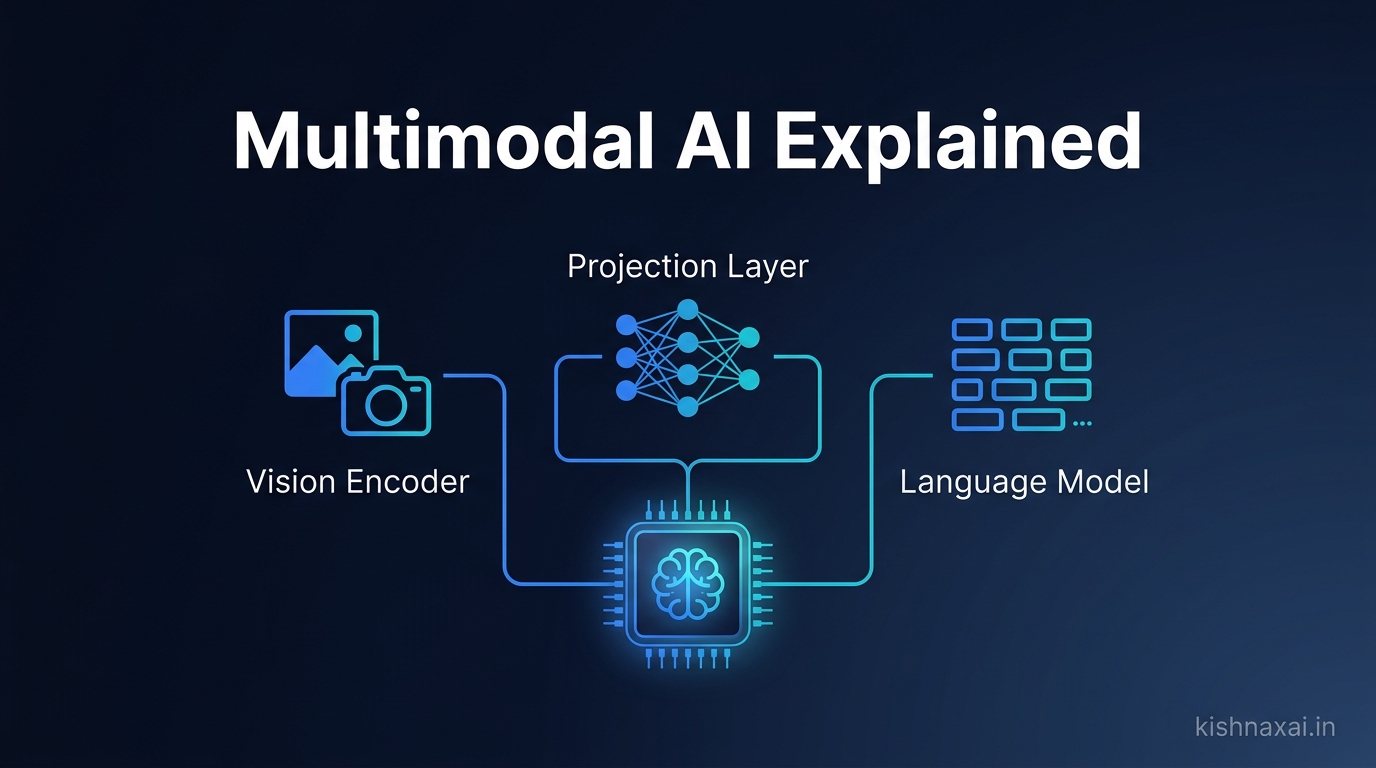
The Problem That Changed AI
Imagine asking ChatGPT: "Can you explain what's wrong with this circuit diagram?"
If the model can only read text, it fails immediately. The answer isn't hidden in words. It's hidden in pixels.
No amount of verbal description perfectly recreates a schematic, a CT scan, or a handwritten invoice. Information encoded visually simply cannot be losslessly reduced to a sequence of tokens.
The next generation of AI wasn't built because language models became smarter at text. It was built because the world isn't made of text.
Humans combine their senses naturally and unconsciously. When you read a map, you simultaneously process spatial geometry, symbolic legend text, and directional context. When a doctor reads an X-ray, they integrate the scan with the patient's history and lab results. When you have a video call, you interpret words, tone, facial expression, and gesture — all at once.
This is not extraordinary. It is the baseline of human cognition.
Early AI systems were built in silos. Language models understood text. Vision models classified images. Speech models transcribed audio. Each was excellent within its domain. Each was completely blind to every other domain.
The problem wasn't that individual models were weak — GPT-3, ResNet, and Whisper were each remarkable. The problem was that the real world doesn't present information in neat, single-modality packets.
Diagram 1 — Human Perception vs. AI Architecture
The architectural parallel between human perception and modern vision-language models is not a coincidence. It is the design goal.
In 2026, over 60% of enterprise AI deployments incorporate at least one multimodal component — up from under 15% in 2023. Understanding how these systems are built is now a core engineering competency.
What Is a Modality?
Most articles on multimodal AI skip this definition. That is a mistake, because once you understand what a modality actually is, the entire architecture of these systems becomes intuitive.
A modality is one way in which information is represented. It is not about content — it is about the mathematical structure used to encode that content.
| Modality | Raw Form | Math Representation | Example |
|---|---|---|---|
| Text | Characters, words | Integer token sequences → dense vectors | Books, emails, code |
| Image | Pixels (H × W × RGB) | 3D tensor [H, W, 3] | Photos, scans, charts |
| Audio | Waveforms over time | 1D signal, mel-spectrograms | Speech, music |
| Video | Image frames + audio | 4D tensor [T, H, W, 3] + audio | CCTV, tutorials |
| Documents | Layout + text + tables | Bounding boxes + tokens + visual patches | PDFs, invoices |
| Sensor Data | Physical measurements | Time series, point clouds | GPS, LiDAR |
Not quite. Two images stored as JPEG and PNG are the same modality. A transcript of a speech and the raw audio waveform are different modalities — they have completely different mathematical structures, even if they contain the same information. Modality is about representation, not format.
Diagram 2 — Modalities Converging into a Shared Embedding Space
Once projected into the same space, the LLM cannot tell whether a token came from a sentence or an image patch.
The critical insight: every modality has a fundamentally different mathematical structure. You cannot simply concatenate a pixel tensor with a word embedding — the numbers mean completely different things. Before any reasoning can happen, these representations must be aligned into one shared mathematical language.
Building that shared space is the central engineering challenge of multimodal AI.
Why Traditional AI Failed at Combining Modalities
Before multimodal architectures existed, engineers tried the obvious approach: run each modality through a specialist model, convert its output to text, then feed that text into an LLM. It seemed reasonable. In practice, it was catastrophically lossy.
Pipeline 1 — Audio to LLM:
Speech recording
      ↓
ASR model (Whisper / DeepSpeech)
      ↓
Plain text transcript
      ↓
LLM
The LLM receives words. Everything else disappears: the speaker's hesitation, the rising tone of a question, the distress in a customer's voice. Sentiment, emphasis, and prosody do not survive transcription.
Pipeline 2 — Image to LLM:
Image
  ↓
Object classifier (ResNet / YOLO)
  ↓
["dog", "grass", "ball", "sunny"]
  ↓
LLM: "The image contains a dog, grass, a ball, and appears sunny."
This fails exactly when spatial reasoning matters. Where is the dog relative to the ball? Is the dog moving toward it? Is the ball partly occluded? All of this is visible in the image. None of it survives the label list.
| Traditional Pipeline | Multimodal Pipeline |
|---|---|
| Image → OCR → Text → LLM | Image → Vision Encoder → Projection → LLM |
| Loses layout and spatial structure | Preserves layout, tables, and position |
| Sequential — modalities never interact | Joint reasoning across modalities simultaneously |
| Text output from classifier limits reasoning | LLM attends to raw visual features directly |
| Fails on charts, signatures, stamps | Interprets documents as spatial objects |
The invoice processing failure makes this concrete. When OCR processes an invoice image, you get:
"Invoice No: 2024-0042 | Date: 15 March | Total: $4,820.00 | Due: 30 days"What disappears silently:
- Spatial relationships that map descriptions to prices
- The company logo that validates authenticity
- Handwritten approval signatures
- Table structure indicating totals versus subtotals
- Watermarks and stamps that signal document status
If you remember only one thing from this section: traditional pipelines convert modalities into text before an LLM sees them. This destroys exactly the information that makes each modality valuable.
How Multimodal AI Actually Works
If you read only one section of this article, read this one. Everything else — architectures, models, applications — is built on these foundations.
Did You Know?
The projection layer in the original LLaVA model — the bridge between the vision encoder and the language model — was trained in under 4 hours on a single A100 GPU. The vision encoder and LLM were both frozen. Only the small MLP projector was trained on 595,000 image-caption pairs. The resulting model could describe images, answer visual questions, and reason about diagrams — from a few hours of alignment training and essentially no vision-specific data.
The core insight is deceptively simple: if you can translate every modality into the same mathematical space, you can reason across all of them using a single model.
Think of it as a universal language. Suppose someone speaks only English and another speaks only French. The difficult solution is to build a translator for every language pair. The elegant solution is to define a universal language that both speakers learn to translate into — then any number of languages can communicate through the same shared space.
Here is the complete data flow for a query like "What is wrong with this circuit diagram?":
Diagram 3 — Full Vision-Language Pipeline
↓ Combined Sequence [256 + 15 = 271 tokens] → LLM Backbone ↓ Text Response
The Vision Encoder
The vision encoder is the model's eye. It takes a raw image — a grid of pixel values — and converts it into a sequence of vectors, one per image patch.
Modern encoders use Vision Transformers (ViT). A 224×224 image split into 14×14 patches produces 256 patch embeddings. Each embedding is a dense vector — typically 1024 dimensions — capturing the visual features of that region. This is analogous to how a text tokenizer splits a sentence into sub-word tokens.
The Projection Layer — The Most Critical Bridge
Here is where most explanations of multimodal AI go wrong: they skip the projection layer entirely.
The vision encoder and the LLM are trained separately. They use different embedding spaces. The vision encoder's representation of a "cat" — a vector encoding pixel edges and textures — is mathematically incompatible with the LLM's representation of the token "cat" — a vector encoding linguistic co-occurrence statistics.
The projection layer is a trainable MLP whose sole job is to translate visual embeddings into the LLM's embedding space. It takes a 1024-dimensional visual vector and outputs a 4096-dimensional vector that lives in the same mathematical neighborhood as the LLM's text tokens.
After projection, the LLM cannot tell whether a token originated from a sentence or from an image patch. Everything is just a token in its familiar space.
import numpy as np

# Vision encoder output: 256 patches, 1024-dim each
visual_embeddings = np.random.randn(256, 1024)

# Projection layer weights (learned during training)
W_proj = np.random.randn(1024, 4096)
b_proj = np.zeros(4096)

# Project visual tokens into LLM embedding space
projected_visual = visual_embeddings @ W_proj + b_proj
# Shape: (256, 4096) — now lives in the same space as text tokens

# Text tokens (15 words) in LLM embedding space
text_tokens = np.random.randn(15, 4096)

# Combined input: visual patches + text — the LLM sees them equally
combined = np.concatenate([projected_visual, text_tokens], axis=0)
print(f"Combined sequence shape: {combined.shape}")
# Combined sequence shape: (271, 4096)
The LLM Backbone
Once projected, the LLM receives a combined sequence of visual and text tokens. Its self-attention mechanism can attend to any token in the combined sequence — visual or textual. This is what enables the model to answer questions about images: the attention heads locate the relevant visual patch and extract the information encoded there.
✓ A modality is a mathematical representation structure, not just a file format
✓ Traditional pipelines fail because they convert modalities to text, discarding spatial and structural context
✓ The projection layer is the critical bridge that translates visual embeddings into the LLM's space
✓ After projection, the LLM processes visual and text tokens identically through self-attention
If you remember only one thing from this section: the projection layer is not a technical detail — it is the entire reason a frozen language model can suddenly understand images.
How Companies Actually Build These
Diagram 4 — How Major AI Labs Approach Multimodal Architecture
OpenAI and Google both train their flagship multimodal models end-to-end on all modalities simultaneously — the most powerful approach, but also the most expensive. Meta's open-source LLaVA family uses a modular design: a frozen CLIP vision encoder, a small trained MLP projector, and an open LLaMA language model. This made it possible for the research community to build capable multimodal models with a fraction of the compute required by unified architectures. Alibaba's Qwen2.5-VL pushed open-weight performance for document and OCR tasks to near-commercial quality, enabling self-hosted production deployments.
Different Multimodal Architectures
Not all multimodal systems follow the same design. Four major architectural families have emerged, each with distinct trade-offs.
Diagram 5 — Four Multimodal Architecture Families
Dual Encoder — CLIP-style
Two separate encoders process each modality independently, and the outputs are compared in a shared embedding space. There is no cross-modal attention during encoding.
Strength: Extremely fast retrieval. Pre-compute embeddings for millions of images, then compare to a text query in milliseconds.
Weakness: Cannot reason across modalities. Because the encoders run independently, CLIP cannot answer "Where is the dog relative to the ball?" — it can only score how similar an image is to a text description.
CLIP learns alignment, not reasoning. It learns that a particular distribution of pixels tends to co-occur with a particular distribution of words — nothing more. It cannot explain what it sees, describe spatial relationships, or answer follow-up questions. That distinction separates retrieval models from vision-language models.
Engineering Mistake — What Early Teams Got Wrong
Most early VLM teams tried to fine-tune the entire LLM during the visual alignment stage — along with the projection layer. The result was consistently worse than freezing the LLM and training only the projector. Why? Fine-tuning the LLM on image-caption pairs caused it to forget language. The model learned to see but lost its ability to reason. The insight that led to LLaVA's success was counterintuitive: less training, not more, produces better multimodal models — because the language backbone already contains everything it needs.
Cross-Attention — Flamingo-style
Cross-attention layers are inserted between a frozen vision encoder and a frozen language model. When the LLM generates text, its attention heads can look directly into the visual feature sequence. The base LLM retains all its language knowledge while the cross-attention layers add visual grounding.
Weakness: The architectural separation limits deep cross-modal integration — the LLM only "consults" the image at specific cross-attention points, not at every layer.
Q-Former Bridge — BLIP-2-style
A lightweight Querying Transformer (Q-Former) with a fixed number of learnable query tokens attends to the vision encoder's output and extracts the most task-relevant visual information. These compressed queries — typically 32 vectors — are passed to the LLM.
Strength: Efficient. Compresses 256 patch embeddings into 32 vectors, dramatically reducing the token count that the LLM must process.
Weakness: Compression can discard fine-grained spatial details critical for OCR or chart reading.
Unified Transformer — GPT-4o / Gemini-style
The most powerful approach: a single transformer trained end-to-end on all modalities simultaneously. Images, text, and audio are all tokenized into one shared sequence, and the model learns to attend across them at every layer.
Strength: Deep cross-modal reasoning. Every attention layer can attend to every token regardless of its modality origin. Gemini 2.0 can process a 1-hour video and answer questions requiring reasoning across both audio and video tracks simultaneously.
Weakness: Extremely expensive to train. Requires massive datasets of carefully aligned multimodal data.
| Model | Company | Architecture | Primary Strength | Best Use Case |
|---|---|---|---|---|
| CLIP | OpenAI | Dual Encoder | Zero-shot retrieval | Image search, classification |
| BLIP-2 | Salesforce | Q-Former + LLM | Efficient visual QA | Captioning, visual chat |
| Flamingo | DeepMind | Cross-Attention | Few-shot learning | Interleaved image-text tasks |
| LLaVA | Open Source | MLP + LLM | Open-weight visual chat | Local deployment, fine-tuning |
| Qwen2.5-VL | Alibaba | Unified | OCR & document reasoning | Invoices, multilingual docs |
| GPT-4o | OpenAI | Unified (native) | General multimodal reasoning | Agentic workflows, complex QA |
| Gemini 2.0 | Unified (native) | Long-context video + docs | 1M-token multimodal analysis |
| Your Goal | Use This | Why |
|---|---|---|
| Image search at scale | CLIP / SigLIP | Pre-computed embeddings, millisecond retrieval |
| Image captioning | BLIP-2 | Efficient Q-Former compression, strong captions |
| Document / OCR tasks | Qwen2.5-VL | Best-in-class fine-grained text recognition |
| Visual chat (local) | LLaVA | Open weights, runs on consumer GPU |
| General multimodal reasoning | GPT-4o / Gemini | Deepest cross-modal integration |
| Long video understanding | Gemini 2.0 | 1M+ context, native video tokens |
If you remember only one thing from this section: architecture choice is not about which model is best — it is about which trade-off fits your specific constraint (latency, cost, accuracy, or privacy).
How Multimodal Models Are Trained
Most explanations of multimodal AI describe what these models do. Very few explain how they learn to do it. That gap matters, because the training process reveals why the shared embedding space works at all.
Contrastive Learning: Building the Shared Space
CLIP, and by extension most modern dual-encoder models, are trained using contrastive learning. The concept is elegant.
Given a batch of image-text pairs scraped from the internet — for example, a photo of a golden retriever paired with the caption "a golden retriever running on a beach" — the model is trained with a simple objective:
- Positive pairs (matching image and caption): push their embeddings close together in the shared space
- Negative pairs (mismatched image and caption): push their embeddings apart
Diagram 6 — Contrastive Learning: How CLIP Builds the Shared Embedding Space
✗ Negative pair (wrong caption) → Loss pushes embeddings apart (low similarity)
After training on 400 million image-text pairs, the shared space develops a remarkable property: semantically similar concepts cluster near each other regardless of which modality they originated from. A photo of a cat, a drawing of a cat, and the sentence "a small feline" all end up in similar regions of the space — not because the model was explicitly told they were related, but because they consistently co-occurred in training data.
This is why cosine similarity works across different data types: they are not different data types anymore. They are all points in the same learned space.
import numpy as np

def contrastive_loss_conceptual(image_embs, text_embs, temperature=0.07):
    """
    Conceptual illustration of CLIP's InfoNCE contrastive loss.
    image_embs: (N, D) — normalized image embeddings
    text_embs:  (N, D) — normalized text embeddings
    Each row i is a matching pair; all other combinations are negatives.
    """
    # Similarity matrix: rows=images, cols=texts
    logits = (image_embs @ text_embs.T) / temperature  # shape: (N, N)

    # Correct pairs are on the diagonal (index 0..N-1 match 0..N-1)
    labels = np.arange(len(image_embs))

    # Cross-entropy loss pushes diagonal high, off-diagonal low
    # (simplified — real implementation uses softmax + log)
    diagonal_scores = logits[labels, labels]
    print(f"Avg matching pair similarity (should be high): {diagonal_scores.mean():.3f}")
    print(f"Avg non-matching similarity (should be low):   {logits.mean():.3f}")

# After training, matching pairs score much higher than random pairs
trained_image = np.array([[0.9, 0.4, 0.1]])   # image of a cat
trained_text  = np.array([[0.88, 0.42, 0.12]]) # "a domestic cat"
unrelated     = np.array([[0.1, -0.9, 0.4]])   # unrelated embedding

print(f"Cat image vs 'a domestic cat': {float(trained_image @ trained_text.T):.3f}")
print(f"Cat image vs unrelated text:   {float(trained_image @ unrelated.T):.3f}")
Staged Training for VLMs
For full vision-language models (not just dual encoders), training typically happens in two stages:
Stage 1 — Alignment pre-training: The vision encoder and LLM are frozen. Only the projection layer is trained on large-scale image-caption pairs. This teaches the projector to map visual features into the LLM's language space — often just a few hours of compute on a single GPU cluster.
Stage 2 — Instruction fine-tuning: The full model (or large parts of it) is fine-tuned on visual instruction-following datasets — conversations about images, visual question answering, document understanding. This teaches the model to respond helpfully to user queries, not just produce captions.
If you remember only one thing from this section: contrastive learning builds the shared embedding space by pulling matching pairs together and pushing mismatched ones apart — until modality stops being a barrier to similarity.
The Evolution of Multimodal AI
Understanding why each generation was created tells you more than memorizing benchmark scores. Each model was a direct response to the primary limitation of the one before it.
Diagram 7 — Evolution Timeline: Why Each Generation Exists
The pattern across this entire timeline is consistent: each generation solved the primary bottleneck of the one before — from classification-only, to retrieval, to generation, to efficiency, to openness, to native multimodality, to context scale. Every model exists because the previous one broke in a specific situation.
Why This Surprised Researchers
When ViT was first proposed in 2020, most computer vision researchers dismissed it. The conventional wisdom was that CNNs had an inherent advantage because convolutions encode spatial locality — a property that seemed essential for image understanding. ViT had none of that inductive bias. Yet trained on enough data, it outperformed every CNN. The lesson: architectural priors matter less than data scale. This same insight later justified training unified transformers on all modalities simultaneously — the model would learn the right structure, given enough examples.
Where Multimodal AI Is Being Used in 2026
For each application below, the structure is the same: what is the problem, why does text-only AI fail, and how does multimodal AI solve it.
Medical Imaging and Diagnostics
Problem: A radiologist must analyze a chest CT scan while correlating it with clinical notes, then determine whether a suspicious region requires biopsy.
Why text-only fails: A text summary of a CT scan — "subtle 8mm nodule in right lower lobe" — loses the exact shape, density gradient, and border characteristics that determine malignancy likelihood. Radiologists read texture and geometry. Descriptions of texture and geometry are not the same thing.
How multimodal AI solves it: Systems like LLaVA-Med accept both the image and clinical report as joint input. The model can attend to the "lower lobe" text token and direct visual attention toward the relevant image region — exactly replicating how a radiologist reads the chart before examining the scan. In 2026, FDA-approved multimodal tools serve as second readers in radiology pipelines, flagging cases for priority review.
Document and Invoice Processing
Problem: Finance teams process thousands of invoices monthly, each with a unique layout from a different vendor.
Why text-only fails: OCR discards layout. A line-item table becomes a flat string of numbers and descriptions with no structure. Matching totals to line items, reading approval stamps, and detecting anomalous amounts requires understanding the document as a spatial object.
How multimodal AI solves it: Models like Qwen2.5-VL process the invoice image directly, preserving spatial structure. They extract structured JSON — line items, quantities, prices, totals — even when the vendor uses a non-standard layout, with near-human accuracy.
Autonomous Driving
Problem: A vehicle must navigate at speed in fog, low light, and heavy rain simultaneously.
Why single-modality AI fails: Cameras fail in fog. Radar fails at detecting pedestrians accurately. LiDAR struggles with rain. Any single sensor is unreliable in some conditions.
How multimodal AI solves it: Sensor fusion across cameras (RGB and infrared), LiDAR point clouds, radar, and GPS creates a joint representation. When the camera is blinded by sun glare, radar and LiDAR maintain situational awareness. No single modality failure can cause a system failure.
Accessibility
Problem: A visually impaired student needs to understand a complex scientific diagram.
Why text-only fails: Alt text captions describe what is in a diagram without explaining what it means. "Diagram showing cell division" provides no educational value.
How multimodal AI solves it: Modern VLMs describe not just content but meaning. Given "Explain this mitosis diagram step by step", GPT-4o produces a structured explanation interpreting arrows, labels, and spatial relationships as the educational content they represent.
✓ Text-only fails when spatial, structural, or contextual information matters
✓ Multimodal succeeds when the model can attend to both modalities simultaneously, not sequentially
✓ The applications where multimodal AI is most valuable are exactly the ones where the world presents information in more than one form at once
Case Study: From Invoice Image to Structured JSON
Here is what a complete multimodal pipeline looks like end-to-end in a real production document processing workflow:
Case Study — Invoice Processing: Image to ERP in 6 Steps
Any vendor format — no template required
Preserves table layout, signature position, stamp location
Visual and text tokens are now in the same mathematical space
"Extract all line items with quantity, unit price, and total"
Layout-aware extraction — tables, stamps, and signatures included
Human review only for flagged anomalies or missing fields
This pipeline replaces 3–5 manual hours per 100 invoices with under 2 seconds of inference. The critical difference from an OCR pipeline: the model never loses the spatial relationships between numbers, descriptions, and totals.
What Surprised Me
While studying multimodal architectures and prototyping with VLMs, the biggest surprise was not about the vision encoder — training a model to understand images was already solved by ViT and CLIP.
The surprise was the projection layer.
My intuition was that the hard part would be the vision encoder. It turned out that the hard part was the translation. Specifically: a two-layer MLP trained for a few hours on image-caption pairs is enough to teach a frozen language model to reason about visual content.
The frozen LLM's general reasoning capability generalized immediately to visual tokens after alignment. The language model already understood the concepts that images represent — it just needed a translator. That is a profound result about what transformers actually learn during language pre-training.
Challenges That Most Articles Don't Talk About
Multimodal benchmarks are impressive. Production deployments are humbling. Here are the challenges that matter when you build real systems.
Modality Alignment in Specialized Domains
Training a vision encoder and a language model to share a meaningful embedding space is not guaranteed for specialized distributions. If the projection layer training data doesn't cover medical images, industrial schematics, or satellite photographs, the projection will be poor — and the LLM will reason incorrectly even if both components are individually strong. Domain shift is a fundamental problem in every specialized multimodal deployment.
Multimodal Hallucination
Language models hallucinate. Multimodal models hallucinate in a new and more dangerous way: they generate confident descriptions of visual content that does not exist in the image. Research in 2025 found that attention failures at the vision-language interface — where the model begins generating text based on language priors rather than actual visual tokens — account for the majority of visual hallucination cases.
OCR and Fine-Grained Text Recognition
Reading text that appears within an image — handwriting, small fonts, low-contrast labels, non-Latin scripts — remains surprisingly difficult. CLIP-based dual encoders are particularly weak here: they learn global image-text similarity and have no mechanism for attending to specific character-level details within a patch.
GPU Memory and Inference Latency
Processing a high-resolution image generates hundreds of visual tokens. Each visual token is a vector that every attention head in every LLM layer must process. At 1024-token image inputs (required for fine-grained document understanding), the compute cost becomes prohibitive without techniques like flash attention and dynamic resolution encoding.
import math

# Self-attention complexity: O(n^2 * d)
d_model = 4096
text_tokens = 512
image_tokens = 256
total_tokens = text_tokens + image_tokens

text_only_ops  = text_tokens ** 2 * d_model
combined_ops   = total_tokens ** 2 * d_model

overhead = combined_ops / text_only_ops
print(f"Multimodal attention overhead vs text-only: {overhead:.2f}x")
# Multimodal attention overhead vs text-only: 2.25x
Prompt Injection Through Images
This is the security challenge that most AI engineering resources in 2025 underestimated.
Because visual tokens pass through the same attention mechanism as text tokens, adversarial instructions embedded in an image — invisible to human observers — can override system prompts, bypass safety filters, and hijack agent actions. Research has demonstrated four practical attack vectors: visible typographic text overlaid on an image, steganographic pixel encoding, adversarial pixel perturbations, and physical-world signage processed by camera-equipped agents.
Privacy and Data Scarcity in Specialized Domains
High-quality multimodal training data is scarce outside general internet domains. Medical imaging datasets require patient consent and institutional approval. Industrial inspection datasets contain proprietary manufacturing information. Unlike text, which can be scraped at scale, aligned multimodal data for specialized domains must be curated and annotated — slowly, expensively, and with significant legal complexity.
Missing Modalities at Inference
A model trained on image-text pairs may handle missing text gracefully, but produce nonsensical outputs when the image is absent or corrupted. Building robust fallback logic across every possible modality combination is a non-trivial engineering problem that most production teams encounter only after deployment.
Where Multimodal AI Is Going
Multimodal AI Agents
The most consequential near-term development is agentic systems that use vision as an input to tool use. An agent that can see a browser, a spreadsheet, or a code editor — and take actions based on what it observes — is qualitatively more powerful than a text-only agent that must receive descriptions of its environment. In 2026, Claude's computer use and GPT-4o's vision API are the early version of agents that will eventually operate across digital and physical interfaces seamlessly.
World Models
The most ambitious research direction is the development of world models: AI systems that build an internal predictive representation of how the physical world works, grounded in visual, audio, and sensor experience. World models are the foundation for robotics and autonomous systems that must plan physical actions in uncertain environments. Current models like Genie 2 and physical world simulators represent the beginning of this trajectory.
Multimodal RAG
Retrieval-Augmented Generation is expanding from text to multimodal inputs. Multimodal RAG systems maintain vector databases of image, audio, and document embeddings alongside text. When a query arrives, the system retrieves the most relevant multimodal context — including charts, schematics, and images — and grounds the LLM's response in that visual evidence. For a deeper look at the retrieval architecture underlying these systems, read our guide on the state of RAG in 2026: hybrid, graph, and agentic retrieval.
Real-Time Multimodal on Device
GPT-4o's live audio and video mode demonstrated that real-time multimodal interaction is possible with frontier models. The engineering challenge in 2026 is bringing this capability to on-device models small enough to run with acceptable latency on consumer hardware — enabling truly local, private, real-time assistants that can see, hear, and respond without sending data to the cloud.
Key Takeaways
If you leave this article with one mental model, let it be this:
Modern AI isn't powerful because it understands text and images separately. It's powerful because it learns a shared representation that allows reasoning across modalities. The vision encoder, the projection layer, and the LLM backbone are not three separate systems — they are one system, unified through a common mathematical language.
- A modality is a mathematical structure, not a file format. Text, images, audio, and sensor data are incompatible mathematical objects that must be aligned before a model can reason across them.
- Traditional pipelines discard information. Converting images to labels or audio to transcripts before an LLM sees them destroys spatial and structural context that cannot be recovered.
- The projection layer is the most important bridge. A small MLP trained for hours can teach a frozen language model to reason about visual content — because the language model already understands the concepts, it just needed a translator.
- Four architecture families exist — dual encoder, cross-attention, Q-Former bridge, and unified transformer — each optimized for different trade-offs between efficiency, capability, and training cost.
- Contrastive learning builds the shared space. Models learn alignment by being trained to pull matching pairs together and push mismatched pairs apart — until modality stops being a barrier to similarity.
- Challenges are real and underappreciated — especially multimodal hallucination, visual prompt injection, domain alignment failure, and GPU memory constraints.
- The field is moving toward unified omni-modal architectures where text, image, audio, and video are all native first-class inputs to a single end-to-end model.
Twenty years ago, computers could barely recognize a handwritten digit.
Today they can watch a video, listen to a conversation, read a document, and explain all three together.
The next leap won't come from adding another modality to the input. It will come from teaching machines to build richer internal models of the world — models that can predict, reason, and plan across every form of information simultaneously.
That is the frontier. And understanding how we got here is the first step toward building what comes next.